Jun 24, 2026
By Jen Kern
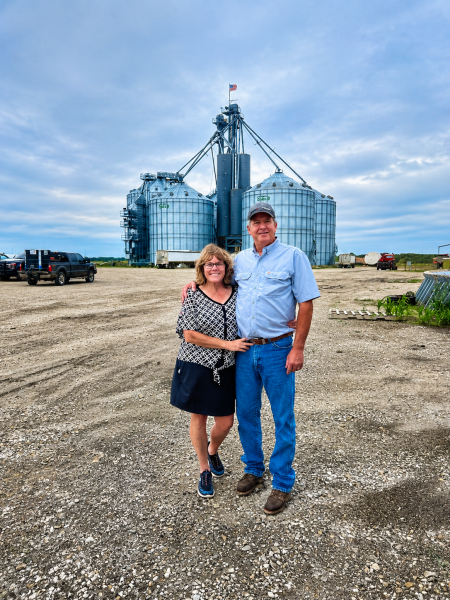
On June 23, I had the opportunity to visit the Moreland Elevator in Braman, Okla., and spend time with owners Matt and Lisa Moreland. What I expected to find was a grain elevator. What I discovered instead was a family business built on trust, innovation, hard work, and a shared vision for the future of agriculture.
The Moreland Elevator is owned and operated by Matt, Lisa, and their three sons—James, Will and David—and their families. Together, they have created something special. While grain handling remains at the heart of the operation, the business has evolved into much more than an elevator. It has become a hub of innovation, value-added agriculture, research, and family-centered leadership.
Matt is quick to credit much of the company's growth to his sons.
"The boys had the vision," he told me several times during the tour. "I just got out of their way and trusted them."
That trust has paid off.
Today, each son owns 20 percent of the business and has developed his own niche within the operation. Following advice from a succession planner, the family focused on finding ways for each son to "add to the pie rather than take a piece of it." The result is a business where everyone contributes unique talents while working toward common goals.
Every morning begins the same way. The Moreland family gathers for breakfast to discuss the day ahead. By 8 a.m., conversations are underway, and by 9 a.m., they present a unified front as work begins. Weekly meetings with their 19 employees help keep projects moving forward, while technology such as WhatsApp keeps everyone connected throughout the day.
Listening to Matt talk about employees, it is clear that they are more than workers to him.
"I consider them family," Lisa said.
Matt’s goal is to create opportunities that keep people employed year-round and help them excel at what they do. One example is the new welding and machine shop where employees can perform equipment repairs and fabrication work during slower farming seasons. Recent equipment purchases from a Wichita business auction have expanded those capabilities even further.
The elevator itself is impressive. The Morelands currently have nearly 1 million bushels of grain storage capacity, including a new 185,000-bushel bin scheduled to come online soon. They also own and operate the historic Hunnewell Elevator, an early-1900s structure with approximately 150,000 bushels of storage capacity. The boys saw potential in the aging elevator, purchased it, and restored it.
Innovation can be found throughout the operation.
The Morelands have invested heavily in grain quality and flexibility. Their drying system allows them to accept grain at moisture levels that many elevators cannot handle. The Moreland Elevator will take wheat and corn up to 17 percent moisture and can dry grain up to 28 percent moisture. During wet harvest years, this capability provides an important service for some local farmers.
Every load is tested for moisture, protein, and test weight. Grain quality data helps producers make marketing decisions and allows the Morelands to identify opportunities to create additional value.
One of those opportunities is value-added corn processing. During my visit, a truck from one of the largest feed companies serving Kansas, Oklahoma, and Texas was loading processed corn. The elevator uses a corn roller to crack corn, making it easier for livestock to digest. Processed grain is shipped to customers throughout the region, including operations as far away as Altus, OK, and Northwest Texas.
The next chapter is already underway. The Morelands recently purchased a small wheat mill that will crack wheat and grind flour. Once installed, it could open new opportunities for value-added wheat products and further strengthen local agricultural markets.
Inside the office, Emily keeps the operation running smoothly, tracking contracts, outgoing loads, customer payments, and grain movement. Managing grain marketing requires constant attention to details such as basis levels, transportation costs, and market opportunities. Through careful marketing and logistics, the Morelands are often able to capture additional value for the grain they handle.
Data drives nearly every decision made on the farm and at the elevator. That focus on data extends to soil health as well.
Every field is soil sampled on a grid. Nutrient levels, soil conditions, and yield data are analyzed to determine exactly where inputs are needed. The family has become strong believers in soil health practices and cover crops.
Matt laughs when he talks about how his views have changed.
"I used to be anti-cover crop," he admitted.
Today, they plant approximately 3,000 acres of rye as a cover crop. The rye provides living roots that support soil microbes, suppresses weeds such as marestail, helps retain moisture, and provides grazing opportunities for cattle. While some practices may seem counterintuitive at first, Matt says the data consistently proves their value.
"Some of it doesn't seem to make sense," he said, "but the data shows that it works."
Technology also helps protect grain quality after harvest. Weather stations mounted above storage bins monitor environmental conditions and automatically control aeration fans. The system manages temperature and humidity to preserve grain quality while maximizing storage efficiency.
Sustainability has become another focus area. Two years ago, the operation received support through a USDA REAP grant that covered approximately 80 percent of the cost of installing solar panels. While the system is designed primarily for on-site energy use, it helps offset operating costs and supports the long-term efficiency of the facility.
Despite all the innovation, family remains at the center of everything.
James and his family live near Drury. Will and his family (wife Aidan is a nurse practitioner at the local hospital) built their home just north of Matt and Lisa's. David and his wife recently built a home a few miles east. The family remains close geographically and personally, creating a unique opportunity to work together every day.
The oldest and youngest sons attended Oklahoma State University, while the middle son attended Kansas State University. Though they followed different educational paths, they returned home with a shared commitment to agriculture and a desire to help build something bigger than themselves.
As I left the Moreland Elevator, I kept thinking about one thing Matt said: the business grew because he trusted his sons to pursue their ideas.
That trust, combined with hard work, data-driven decision-making, and a willingness to embrace innovation, has transformed a family farm and elevator into a model for what rural agriculture can become.
The Moreland Elevator isn't simply storing grain. It is building opportunities, supporting local farmers, creating jobs, investing in the future, and proving that family businesses can thrive when each generation is given room to dream.
In Braman, Okla., the Morelands are showing that the future of agriculture is not just about bushels and bins—it's about people.