Jun 18, 2026
By Jen Kern
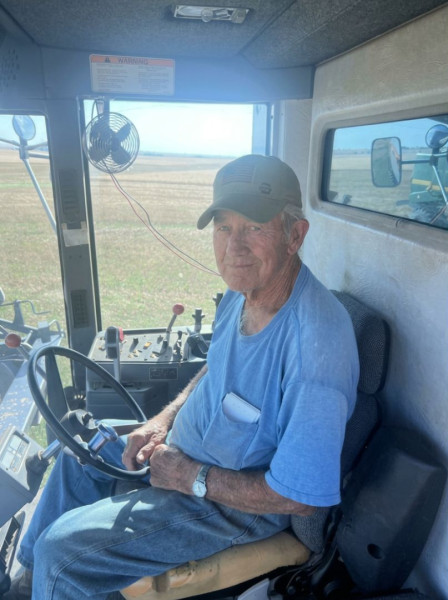
On June 10, I had the opportunity to spend part of the wheat harvest with the Wencel family and ride in the combine with 82-year-old Wayne Wencel. As golden wheat disappeared beneath the header and grain poured steadily into the hopper, it became clear that this harvest was about much more than wheat. It was about family, heritage, resilience, and a lifetime spent caring for the same land.
For Wayne Wencel, farming has never been just a way to make a living. It is simply who he is.
He planted his first crop at eighteen years old as a high school senior and harvested it later that same year. More than six decades later, at 82 years old, he still finds joy in the rhythm of farm life—the wheat harvest, caring for cattle, and watching the land produce another crop.
Over the decades, he built a life around both wheat and cattle. Farming has never simply been an occupation. It has been a calling.
The land itself tells the story of the Wencel family. In 1867, Anton and Marie Wencel immigrated from Czechoslovakia, first settling in Nebraska before eventually making their way to Kansas. Like many immigrant families of the era, they came seeking opportunity and a chance to build a better life for future generations.
The Wencels are part of the Czech community that settled west of Caldwell in the late 1800s. Wayne proudly describes himself as one of the last full-blooded Czechs in the area. While the Czech community was once strong throughout Sumner County, its numbers have dwindled over the years. Still, many of its traditions, stories, and values remain alive through families like the Wencels.
Anton and Marie eventually passed the family land on to their son, John Wencel. But adventure called to John, and when the Oklahoma Land Run opened new opportunities, he returned the Kansas land to his parents and headed south to claim land in Oklahoma.
Wayne still treasures one of the family's most tangible connections to that chapter of history—John's gun from the Land Run era.
Although John initially found opportunity in Oklahoma, drought and difficult times eventually led him back to Kansas. He returned to the Caldwell area and once again farmed the same ground that remains in the Wencel family today.
The farm then passed from generation to generation: from John and Nellie Wencel to their son Frank, from Frank and Rose Wencel to Wayne. Today, Robbie's son, Sam, is helping carry on the tradition, making him the fifth generation of Wencels to work the family's land.
Wayne's connection to the land runs deeper than ownership. It is measured in memories, in seasons of abundance and hardship, and in the understanding that he is simply one steward in a long line of caretakers.
Wayne was born in 1943, the same year electricity finally arrived at the family farm. Years later, when his mother was nearing the end of her life, he asked her what she remembered most about living on the farm.
Her answer surprised him.
"Getting electricity," she told him.
Before electricity, daily life required hard work that many people today can scarcely imagine. Chickens had to be cooked immediately after butchering because refrigeration was unavailable. Every task required more labor and more planning than it does today.
Growing up west of Caldwell, Wayne attended the Scott Schoolhouse, one of the many one-room country schools that once dotted the Kansas countryside. About fourteen students attended the school, ranging from preschool through sixth grade.
When Wayne eventually moved on to Caldwell schools, he encountered things country schools couldn't offer—organized sports, larger classes, indoor plumbing, and, as he laughs, "girls."
The Scott Schoolhouse remained a meaningful part of his life. Years later, he purchased the land where it stood. Although the historic building was recently lost to fire, the memories created there remain. For Wayne, it represents a piece of rural America that has largely disappeared.
Perhaps no one understood Wayne better than his son, Robbie.
Those who knew them often recall the spirited discussions between father and son over how things should be done on the farm. Like many farming families, there were disagreements over equipment, planting decisions, or the best way to tackle a job. To an outsider, it might have sounded like bickering.
But those closest to them knew better.
Theirs was a bond forged through long days in the field, shared work, and a mutual love of farming. Their back-and-forth conversations were, in many ways, their own language—a reflection of how much they cared about the land and about doing things right.
The years have not been without hardship.
Wayne carries the loss of his son Robbie and the loss of his wife Sarah with him every day. Yet even amid grief, he remains grateful.
Wayne and Sarah spent many years attending Czech festivals and celebrating the heritage that shaped their family. He still treasures family heirlooms, including the rosary his mother brought with her from Czechoslovakia as a young immigrant. These connections to the past remain important reminders of where the family came from and the sacrifices made by previous generations.
This year's harvest brought one of those moments when the past and present seemed to meet.
As Wayne looked across the fields, he watched Robbie's son carrying on the family tradition from the seat of a combine while his daughter, Tyann, brought burgers out to the harvest crew. Looking across the field, Wayne could see multiple generations working together on the same land his ancestors settled generations ago.
It was a reminder that while loss becomes part of a person's story, it does not have to be the end of the story.
At 82 years old, Wayne still loves farming.
As the combines move through another Kansas wheat harvest, Wayne Wencel represents something increasingly rare—a living connection between the pioneers who settled this land and the generations who will farm it in the future.
The wheat fields surrounding Caldwell have changed over the decades. Technology has changed. Communities have changed. But the values of hard work, family, faith, and stewardship of the land remain.
Those values are written across every acre Wayne Wencel has farmed and every generation he has helped raise.
And as another harvest comes in, they continue to grow.